

What started as 93 hectare field trials in Central Java has grown into a five-year strategic alliance - targeting 50,000 tonnes of sustainably grown rice and a new chapter for regional food security.
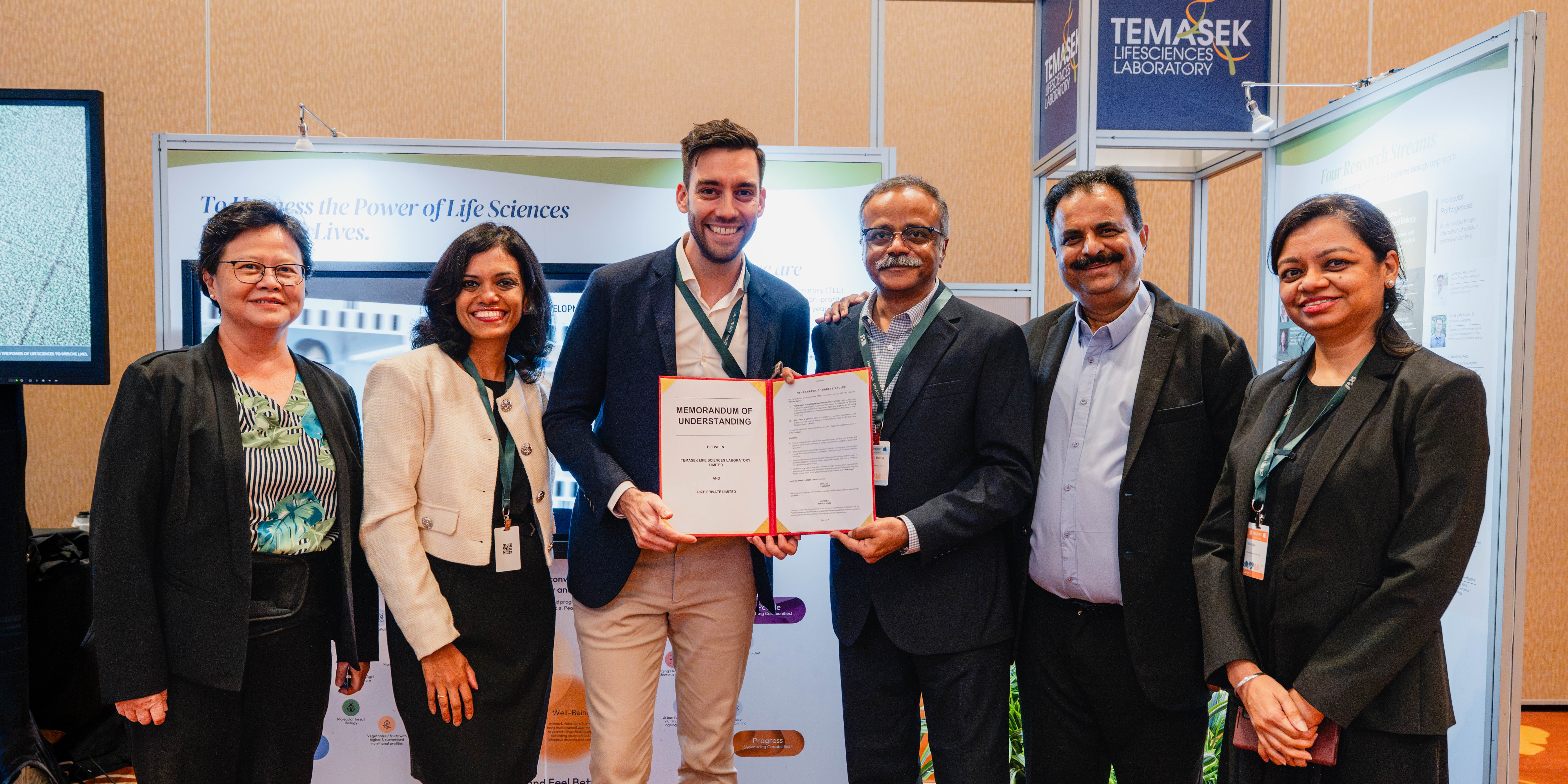
Singapore, May 2026 -- Rize, Southeast Asia's leading agricultural technology company focused on modernising rice farming, and Temasek Life Sciences Laboratory (TLL), a leading Singapore-based research institute in plant science and agri-tech innovation, today announced the signing of a renewed Memorandum of Understanding (MOU), marking a significant expansion of a collaboration that first took root in the paddy fields of Central Java.
In July 2025, the two organisations announced the launch of large-scale field trials in Indonesia, a science-backed effort to reduce greenhouse gas emissions from rice cultivation without compromising yields or farmer livelihoods. Less than a year on, that work has validated enough to warrant a step change: a five-year strategic partnership aimed at bringing low-emission rice from large-scale validation trials to commercial scale.
The renewed Memorandum of Understanding (MoU) reinforces a shared ambition: to bridge cutting-edge scientific innovation with on-the-ground implementation, enabling sustainable rice cultivation that improves farmer livelihoods while reducing climate impact.
From Central Java to a Regional Blueprint
The Rize - TLL collaboration began with one question: could science proven in controlled settings actually work across hundreds of hectares, with real farmers, in real conditions and thus can be scaled.
The field trials in Central Java, supported by the Philanthropy Asia Alliance and its members, and executed in partnership with Badan Perakitan dan Modernisasi Pertanian: BRMP, were built to answer exactly that. Running across two growing seasons, the trials tested a combination of water management, and nutrient management options, measuring emissions at plot level with lab-grade precision, and tracking the impact on soil health, crop yields and farmer income in parallel.
Key milestones from the initial collaboration include:
- 93 hectares enrolled in field trials in Central Java
- 30-35% methane reduction vs. conventional practice
- 5% increase in yield with TLL optimised rate fertilizer
- 5-6% increase in net returns across trial plots
- 173 smallholder farmers reached through the programme
"Many innovations in agriculture show strong promise but fail to scale, not because the science is wrong, but because the enabling environment and business models are not there. Rize exists to bridge that gap, by integrating science, practical application, and market forces into a model that can grow sustainably, with farmers at the centre, " said Sheetal Sharma, Head of Innovation & Carbon, Rize. "What the TLL project demonstrated is that climate-smart practices can move beyond pilots and deliver real impact at scale. That is a significant threshold to cross," she added.
What Comes Next
The renewed partnership sets its sights on scale. The next phase targets the production of 50,000 tonnes of sustainably grown, low-emission rice, with Vietnam and Indonesia as the launchpad and the broader region as the horizon.
TLL brings over 25 years of agrobiology expertise, in climate-resilient rice varieties, soil microbiome science, and the rigorous agronomic protocols that make emissions reductions measurable and credible. Rize translates this science into impact, through deep farmer engagement, large-scale field implementation, and robust MRV systems that generate high-integrity data trusted by markets, governments, and carbon standards.
Both organisations will deepen their collaboration across science, implementation, and market development, with a particular focus on creating traceable, verified supply chains of sustainably grown rice that can serve both commercial buyers and Singapore's food security ambitions.
Together, the partnership is focused on something the industry has long talked about and rarely delivered: a verified, traceable supply of low-emission rice that connects field-level science to commercial and food security outcomes.
"Rice is the world's most consequential crop, for food, for water, for the climate. Getting it right matters enormously. What this partnership has demonstrated is that getting it right does not require farmers to sacrifice anything. That is a significant finding. The next five years are about making it the norm, not the exception," said Dhruv Sawhney, CEO, Rize. "The scale-up will create a strong demand signal for the whole ecosystem, and for the industry, that a better, smarter alternative is here to stay," he further added.
“We are encouraged by the validation of our science-based solutions across large-scale trials in Indonesia and beyond. This collaboration demonstrates that improving farmer livelihoods and advancing sustainable farming are not competing goals — they can and must go hand in hand. By scaling these innovations across Southeast Asia, we aim not only to address a regional climate challenge but also to strengthen Singapore's food resilience through low-emission rice production that is science-backed and field-proven. There is still much work ahead, but we now have the platform and shared commitment to take these findings to the scale they deserve," said Peter Chia Leong Bin, CEO, Temasek Life Sciences Laboratory.
The Stakes
Rice feeds more than half the world, and produces roughly 12% of global methane emissions, a climate toll comparable to the entire aviation industry. It also consumes around 30% of the world's freshwater. The world cannot reach net-zero without addressing how rice is grown. And it cannot address how rice is grown without working directly with the farmers who grow it.
That is what Rize and TLL are building toward: a model where sustainability is not an ask of farmers, but an outcome they share in, measurable in reduced emissions, proven in better yields, and felt in higher incomes.
For Singapore, the stakes are also close to home. As the city-state works toward greater food resilience and lower-carbon supply chains, a proven, scalable source of low-emission rice from the region is both a climate imperative and a national priority.
- END -
About Rize
Rize is Southeast Asia's leading agricultural technology company dedicated to decarbonising rice farming. Operating across Indonesia and Vietnam, Rize partners with smallholder farmers to implement proven low-emission practices, supported by on-the-ground agronomists, field-level data, and rigorous MRV systems. Rize's mission is to empower farmers, transform rice, and regenerate the planet, cutting 500 million metric tonnes of CO2e by 2040. Backed by Temasek (GenZero), Wavemaker Impact, and Breakthrough Energy Ventures. Learn more at www.rize.farm
About Temasek Life Sciences Laboratory (TLL)
Founded in 2002, Temasek Life Sciences Laboratory is a non-profit organization focusing on research in molecular biology and genetics that impacts agriculture, food, industrial biotechnology, and human health. Through innovative partnerships and sustainable solutions, TLL strives to contribute to global sustainability and economic development.
Media Contacts
Rize: Saheen Rahman | [email protected] | +91 8134981213
TLL: Tan Teng Li (Christy)| [email protected]


