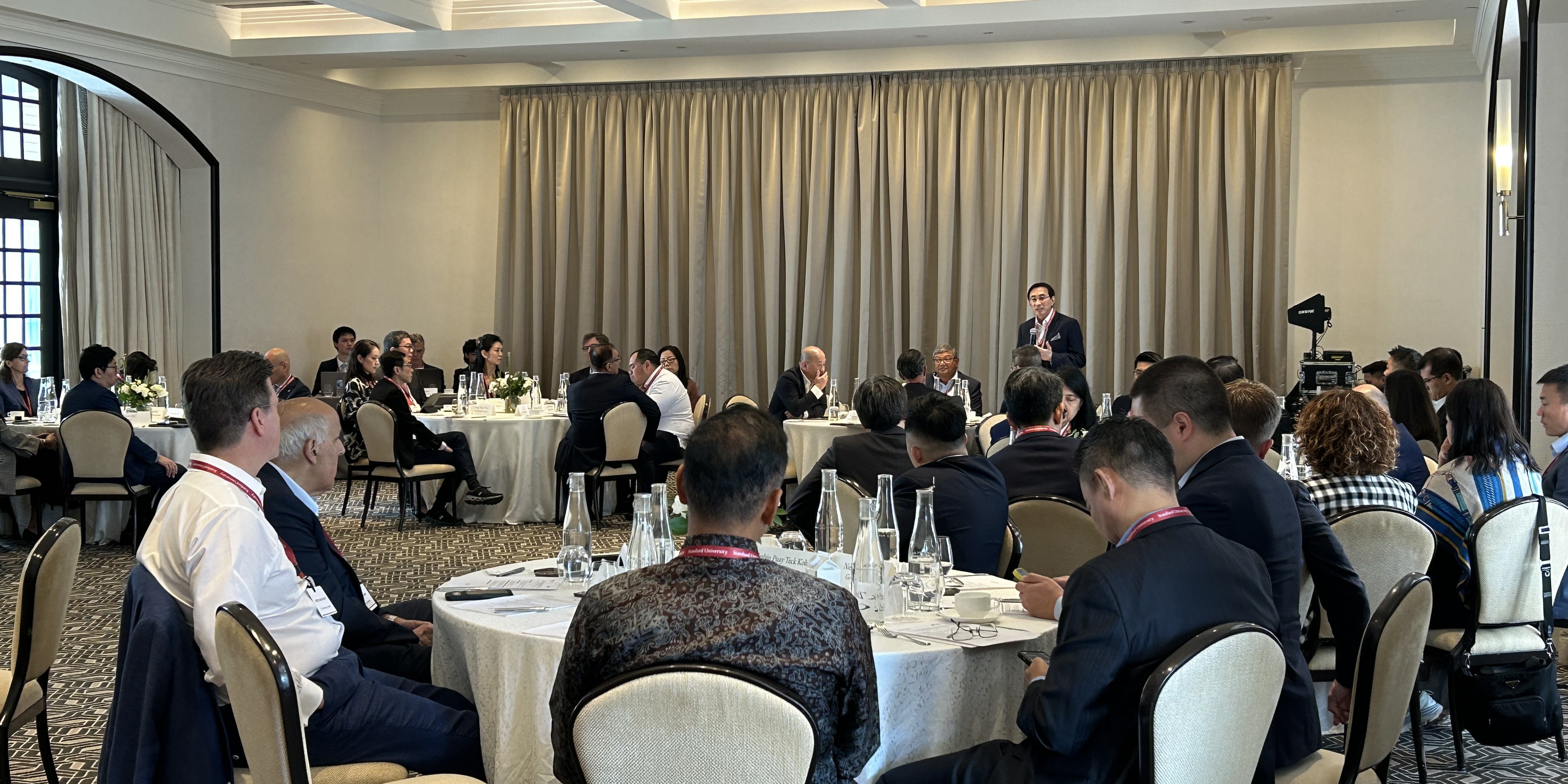


A roundtable co-organised by the Stanford Doerr School of Sustainability, its Precourt Institute for Energy, and Temasek Trust brought together leading investors, industry executives, academics, and policymakers to examine a shared challenge: how capital can be mobilised for sustainable growth while safeguarding fiduciary responsibility.
Among the discussion leaders were Ms. Kyung-Ah Park, Chief Sustainability Officer, Temasek International, and Mr. Russell Tham, Managing Director and Head of Emerging Technologies, Temasek International. Mr. Desmond Kuek, Executive Director & CEO of Temasek Trust, set the stage at the beginning of the day alongside Mr. Arun Majumdar, Dean of Stanford’s Doerr School of Sustainability.
"Sustainability, as we have traditionally defined it, is no longer enough. The next frontier is impact."
— Mr. Desmond Kuek, Executive Director and CEO of Temasek Trust
Urging that capital be deployed with intent and additionality — so that each dollar mobilises more and moves solutions from pilot to scale — Mr. Desmond Kuek added that what the world now needs is impact that is measurable, scalable, and transformative. Read his full remarks here.
The candid discussions that followed ranged across capital markets, innovation ecosystems, geopolitical shifts, and Southeast Asia’s pivotal role in shaping solutions for a rapidly-changing world.
A 10X World Demands New Rules
Over the past 100 years, the global population, GDP, and resource use have multiplied, while technology, geopolitics, and climate risks have fundamentally altered the landscape we operate in. In this context, relying on past data and familiar models is no longer enough. The biggest risk, participants agreed, is standing still.
Southeast Asia sits at the centre of these pressures. With a population of over 700 million, the region is grappling with uneven growth, rising energy demand, environmental strain, and inequality. The choices made here — what gets built, financed, and scaled — will shape global outcomes.
Participants noted that there is growing momentum in areas like renewables and ocean conservation, with stronger collaboration across sectors. The challenge now is speed — and how we enable promising pilots to scale into viable solutions.
Why Investors Struggle to Innovate — and Why They Must
The topic of the first discussion unpacked a hard truth: investors are not built to innovate, yet innovation is now part of the job.
Institutional investors face multiple constraints when considering sustainable investments:
- Volatile risk-adjusted returns, especially in areas like the energy transition, due to policy uncertainty, geopolitics, and cost of capital
- Mismatched time horizons, where long-term convictions are judged against short-term performance metrics
- Asset allocation frameworks struggle to evaluate emerging areas such as nature-based solutions
- Benchmark-driven behaviour pushes investors towards established industries, overlooking environmental and social costs
Yet, large pools of capital across pension funds, sovereign funds, insurers, and family offices are exposed to long-term systemic risks that cannot be diversified away through traditional portfolio strategies.
Channeling this capital towards sustainable investments will require rethinking how investment decisions are made. Better data and clearer metrics are essential, both to manage risk and to give decision-makers the confidence to back new solutions at scale.
From Proof-of-Concept to Proof-of-Scale
A recurring challenge surfaced throughout the day: many sustainability solutions reach proof-of-concept but struggle to scale.
Barriers include fragmented markets, weak offtake demand, and limited mechanisms to share early-stage risk. In Southeast Asia, this is compounded by differing regulatory regimes and uneven institutional capacity.
Participants highlighted several conditions necessary to help innovations bridge the “valley of death” between proof-of-concept to commercial viability:
- Flexible mandates that allow investors to operate across risk profiles
- Blended finance to de-risk start-ups and crowd in larger pools of capital
- Harmonised regulations, particularly in energy and waste
- Strong founding teams, supported by engaged boards
Sustainability Amid Geopolitical Fracture
Another conversation examined sustainability in a more divided world. As global power dynamics shift and supply chains realign, trade, technology, and capital flows are being reshaped. For Southeast Asia, this creates both risk and opportunity.
Fragmented supply chains may raise costs and uncertainty, but they can also drive local innovation and resilience. Discussants made the case that investments in electrification and energy storage should not be seen just as climate priorities, but as strong long-term business opportunities.
At the same time, higher financing costs, policy swings, and geopolitical tensions are slowing progress in some markets. Navigating this landscape will require closer coordination between policymakers, investors, and innovators, along with more cross-border collaboration.
Shared Takeaways
By the end of the roundtable, several clear themes stood out:
- The goal is to move beyond "sustainable investing" to just "investing" — with impact embedded by default and profitability embedded in impact
- De-risking is essential to allow new technologies and business models to scale
- Geopolitical tensions present both risks and opportunities, underscoring the need for stronger collaboration
Participants agreed that progress will depend on better tools for investors, more enabling policy environments, and stronger innovation ecosystems that can translate ideas into scale.
Philanthropy can help by taking early risk, proving new models, and crowding in larger pools of capital — but lasting impact will require coordinated action across sectors.
The urgency was clear: in a decade likely defined by rapid innovation and rapid disruption, collaboration across capital, policy, and innovation will determine whether global ambitions translate into real-world change.
To stay updated, subscribe to our Impact Brief newsletter and follow us on LinkedIn, Instagram, Facebook, and YouTube.


